
How We Learned to Keep the Rain
Water retention in Alentejo — what we built, why it works, and what happened next.
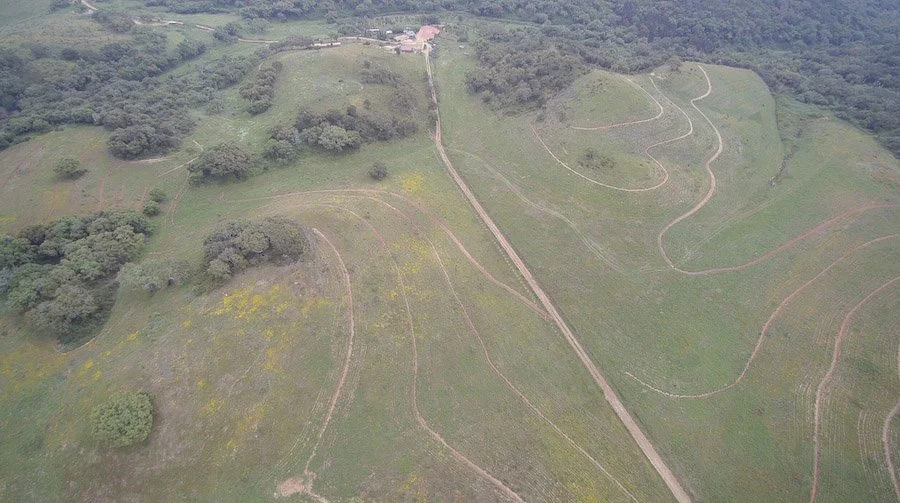
Alentejo gets about 600mm of rain per year. The problem isn't the amount. It's the timing. Almost all of it falls between October and March — and then stops completely for six months.
The problem with rain in a dryland climate
When we arrived at A Quinta, the land had a water problem that wasn't immediately obvious. We had rain. But we didn't have water.
The distinction matters. Rain falls. Water stays. On degraded, compacted land — which is what we inherited — rain hits the surface, can't penetrate, and runs off. By January, streams that had been dry since April were running again. By March, they'd slowed. By May, they were gone. The rain had passed through without stopping.
Alentejo's summer is long and brutal. Temperatures regularly above 40°C. Zero rainfall for five to six months. Every drop of October-to-March rain that runs off the farm is rain we'll miss desperately in August.
One of the permaculture solutions to improving soil structure and water retention is earthworks. — physical structures that slow, spread, and sink rainfall into the landscape before it can run off. We started building our first of many different kind of earthworks (ponds, dams and swale, keyline plough)
What we built — and how
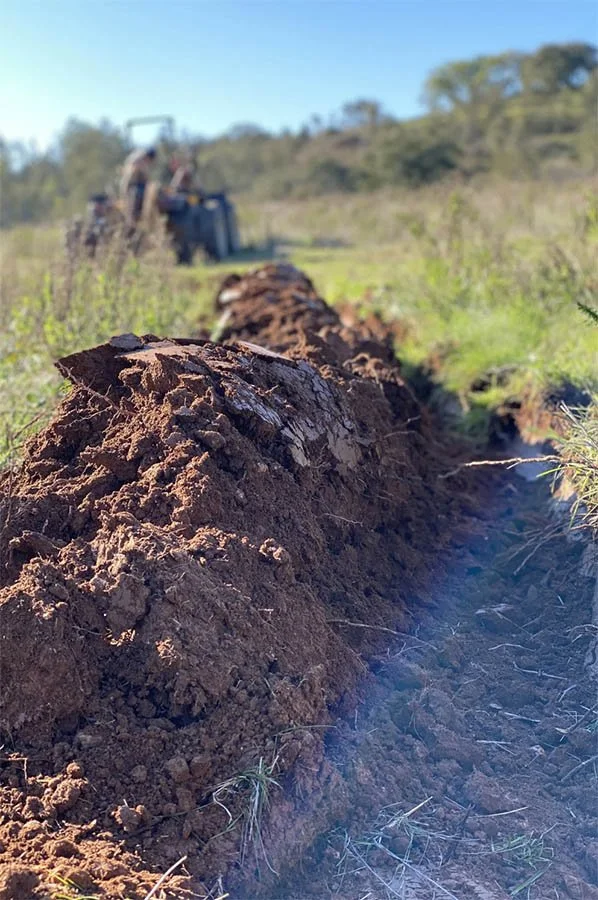
Swales are one strategy to improve soil structure and water retention. A swale is a trench dug on contour — meaning it follows the curve of the land at a constant elevation, rather than running downhill. Water that flows into a swale spreads evenly along it, then slowly sinks into the soil rather than rushing downslope.
Our main swale system runs across a hillside that was previously almost completely bare and degraded. We designed the line using an A-frame level — a simple, cheap tool helps mark a countour.
Above each swale berm, we planted trees. The swale acts as a permanent irrigation system for the trees below it — capturing rainfall and slowly releasing it into the root zone. The trees stabilise the berm, which stabilises the swale.
The swale is the simplest water-retention structure when applied in the right context. It's just a trench on a curve. But on a slope that used to shed every drop of rain, it changed everything.
We also built a pond
At the lowest point of the main slope, we excavated a small pond — less than 100 square metres, about 1.5 metres deep at its deepest. This serves multiple functions. It catches any overflow from the swale system above it. It provides water for wildlife — birds, frogs, and insects — which are all indicators of ecosystem health. It acts as a fire break. And it's beautiful, which matters more than people admit.
The pond filled in its first winter and has held water through three summers — one of which was the driest on record in the region. This surprised us. The watershed above the pond, improved by the swales and the vegetation we've established, now functions as a catchment. Rain falls higher up, sinks into the soil, travels slowly downhill through the soil profile, and reaches the pond over weeks rather than hours.
What changed after the earthworks
First spring after swale installation: trees planted below the swale showed dramatically better establishment rates than those planted on bare slopes.
Second summer: we did not irrigate the food forest at all above the swale line. In a climate that routinely goes 5 months without rain. The swale storage carried them through.
Third year: vegetation on the slope between swales closed in completely. Ground cover established. The exposed soil that had been baking every summer was now shaded and protected.
Fourth year: the slope is unrecognisable from what we inherited. The swales themselves are invisible under the vegetation. The water infrastructure has become part of the landscape.
The human side of water design
There's something about water on land that touches something deep. We've had participants in our courses who spent an entire afternoon watching water move through the landscape after rain — following it, observing where it pooled, where it sank, where it ran. Nobody asked them to do this. They just couldn't stop observing and interacting.
Water design is one of the most viscerally satisfying parts of permaculture practice. After observing and reading the landscape, you change the land. Then you watch the land change. Then you watch everything else change around it. The sequence is reliably astonishing.
Watching rain fill the swales for the first time, spread along the contour, and sink into the hillside rather than run off — that's when permaculture stopped being an idea and became something we could see and touch.
What this means for dryland farming
If you're farming or gardening in a Mediterranean or dryland climate — Portugal, Spain, southern France, Greece, much of California — water design is not optional. It is the foundation everything else is built on.
You can have the best soil, the best plants, the most knowledgeable team — but if you haven't designed your landscape to hold water, you will spend your dry season fighting the land instead of working with it.
This is what our Oasis Design course is built around: five days focused on water-wise and dryland design, using A Quinta as the learning landscape. Everything we built is there to walk, to study, to understand from the inside.
See All Our Courses at A Quinta
At A Quinta, we share practical knowledge around regenerative living, permaculture, natural building, community, and land stewardship. Our vision is to create a inspiring landscape that supports people, animals, and the wider ecosystem. We aim to be a place of learning, connection, and hands-on experience, where people can deepen their relationship with themselves, each other, and the natural world.